For a known brand there is the Technaxx, for always-on simplicity the mains-powered 4YourHome, for more than one radiator the Coopers of Stortford two-pack, and for the cheapest way to try one the UrbanHui magnetic three-fan set. But first, the honest truth: there is no independent proof these cut your heating bill much, so treat them as a comfort product, more even warmth, not a guaranteed saving. The one genuinely big saving is indirect, and it comes from being able to turn your thermostat down, not from the fan. Below we explain what they actually do, where they help most, and what to skip.
Last reviewed 21 October 2026
Prices and stock on this page are pulled live from each listing and refresh several times a day. A radiator booster fan gently pushes the warm air trapped above your radiator out into the room, for only a few watts, so it can make a cold or slow room feel more even. Here is the honest bit: there is no independent, measured proof they cut your heating bill by much, so treat them as a comfort product with a possible small saving, not a money-saver. The one big saving is indirect, and comes from your thermostat, not the fan. The Esjay is our pick. How we choose: we compare the live Amazon listings, the makers' published specs and the owner reviews, including the 1 to 3 star ones, and we don't test hands-on, so we never claim to.
The top 5, ranked
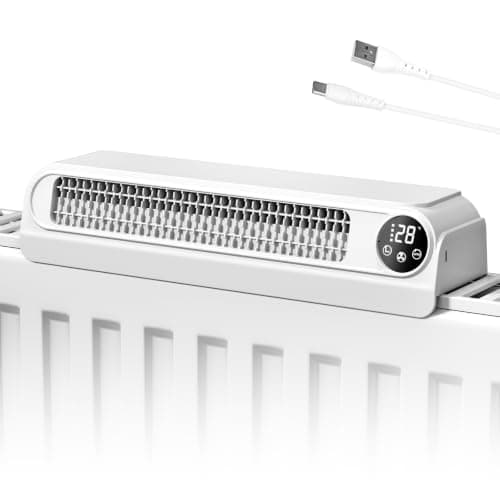 ★ Our pick · Best overallEsjay Radiator Fan Booster (Smart, Cordless)Cordless, rechargeable and thermostatic, so it runs itself and leaves no trailing wire.£45.99In stockBuy on Amazon
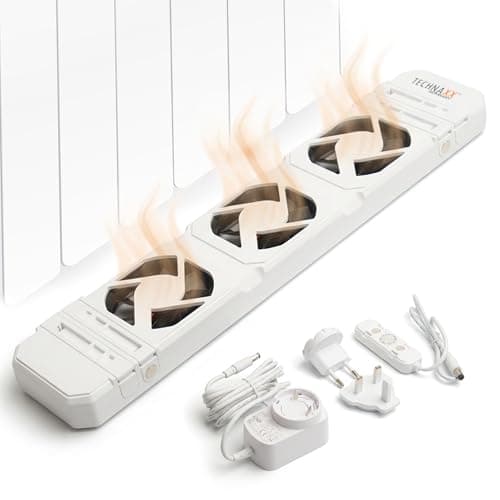 Best valueTechnaxx Radiator Fan Mono SetA thermostatic booster from a known brand, sized for 50 to 70cm radiators.£32.99In stockBuy on Amazon
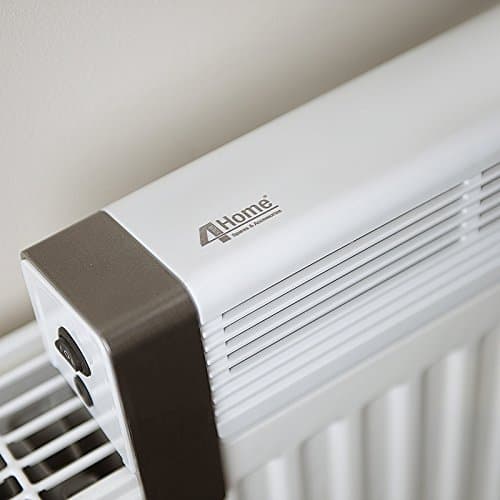 Best mains-powered4YourHome Electric Radiator Fan (12W, Low Noise)Plug it in and it just runs quietly, with no battery to recharge, ever.£39.99In stockBuy on Amazon
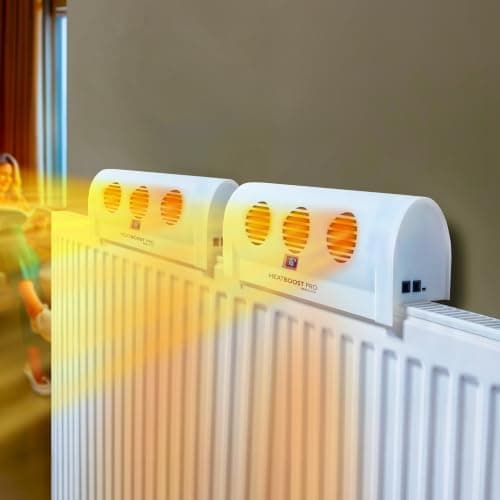 Best for multiple radiatorsCoopers of Stortford HeatBoost Pro (Pack of 2)Two thermostatic boosters in one box, so you can do more than one radiator cheaply.£49.99In stockBuy on Amazon
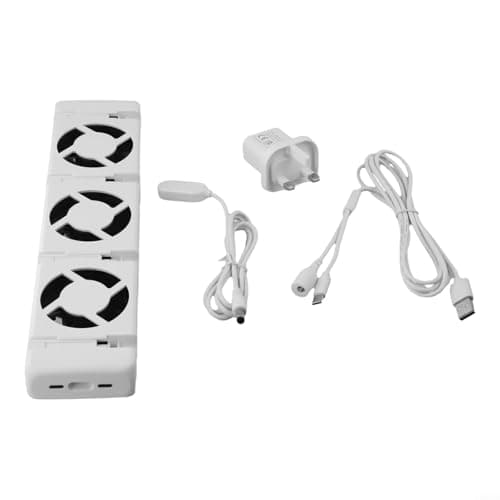 Best budgetUrbanHui Radiator Magnetic Fan (3-Fan Set)A magnetic three-fan set with a temperature sensor, the cheapest way to try one.£28.09In stockBuy on Amazon
Compare the specs
| Product | Power | Power source | Control | Best for | Price |
|---|---|---|---|---|---|
| Esjay Radiator Fan Booster (Smart, Cordless)★ Best Overall | Low (a few watts) | Cordless (rechargeable) | Thermostatic auto on/off | A tidy, automatic booster | £45.99 |
| Technaxx Radiator Fan Mono SetBest Value | Low (a few watts) | Mains | Thermostatic | Value from a known brand | £32.99 |
| 4YourHome Electric Radiator Fan (12W, Low Noise)Best Mains-Powered | 12W | Mains | Basic/thermostat | Always-on, no recharging | £39.99 |
| Coopers of Stortford HeatBoost Pro (Pack of 2)Best for Multiple Radiators | Low (a few watts) | Mains | Thermostatic | Doing two radiators | £49.99 |
| UrbanHui Radiator Magnetic Fan (3-Fan Set)Best Budget | Low (a few watts) | Cordless/USB | Temperature sensor | Cheapest way to try one | £28.09 |
Prices are live from Amazon and refresh through the day; last page update 21 October 2026.
Do radiator booster fans actually work?
Yes, but be clear about what "work" means. A radiator booster fan genuinely moves more of your radiator's warm air out into the room, and it does it for only a few watts. What it does not reliably do is cut your heating bill by much, so the honest answer is: it is a comfort upgrade, not a money-saver.
- There is no independent, measured proof that they cut heating bills much. The Energy Saving Trust, the usual authority on home-heating savings, does not cover radiator fans at all.
- Be wary of the "about £140 a year" claim. That figure traces back to an old 2009 trial cited by sellers, and should be treated with caution rather than taken as a current, verified saving.
- A realistic estimate is far smaller: more like 6 to 14 pounds per radiator per year. Real, but not life-changing.
So buy one to make a cold or slow room feel more even and to warm up a bit faster, with a small possible saving as a side-effect. Do not buy one expecting it to slash your bills.
How a radiator fan helps (and where it helps most)
A radiator heats the room mostly by warming the air touching it, and that warm air naturally rises. Left alone, a lot of it drifts straight up the wall and across the ceiling before it ever reaches you. A booster fan sits on or under the radiator and gently pushes that warm air out into the room instead, so more of the heat you are already paying for ends up where you sit.
Because it only moves air that is already warm, it draws very little power: typically about 2 to 7 watts per the makers' own specs, around 5W being common. At the Ofgem price cap of 26.32p per kWh (1 October to 31 December 2026) that is pennies a year to run.
It helps most where heat is getting trapped or struggling to reach you:
- A radiator behind a sofa or under a shelf, where the heat is blocked or diverted
- A radiator under a window, where rising heat meets cold glass
- A tall or cold room that is slow to warm up
- A radiator far from where you sit, so the warmth never quite reaches you
In a small, already well-heated room with the radiator in the open, a booster fan has far less to do, so you will notice it least there.
Cordless vs mains, and what to look for
- Thermostatic auto on/off is the feature worth having. It means the fan senses when the radiator is warm, switches itself on, and switches off again when it cools, so it only runs when there is heat to move and you never have to touch it.
- Cordless (rechargeable) is the tidiest: no plug, no trailing wire, so it sits neatly on the radiator. The trade-off is you have to recharge it now and then.
- Mains-powered never needs recharging and can run all winter, but needs a socket nearby and a wire to tuck away. A low-noise mains model is a good "fit and forget" choice.
- Fit: most clip or sit on the top of a panel radiator, and some use magnets to grab a steel panel, which is quick and tool-free.
- Noise: these should be quiet. Owner reviews are the best guide here, so check the 1 to 3 star ones for anyone complaining about a buzz.
Worth knowing: SpeedComfort is the best-known UK radiator-booster brand, but it is not always available on Amazon, so we have left it out of the picks and mention it only as context.
Our picks in detail
Esjay Radiator Fan Booster (Smart, Cordless)
Cordless, rechargeable and thermostatic, so it runs itself and leaves no trailing wire.
A well-rated cordless radiator booster fan.
The Esjay is the radiator booster fan most people should buy. It is cordless and rechargeable, so there is no plug or trailing wire cluttering the skirting board, and it is thermostatic: it senses when the radiator warms up, switches itself on automatically, and switches off again once the radiator cools. That means you set it on the radiator and forget it, and it only runs when there is actually warm air to move. It draws just a few watts, so running cost is pennies, and it quietly pushes the heat that pools above the radiator out into the room where you want it.
The one honest downside is the battery: being cordless, it needs recharging periodically, so it is not quite fit-and-forget forever like a mains model. And like every booster fan, it is a comfort upgrade, not a guaranteed bill-cutter, so buy it to make a cold or slow room feel more even, not to slash your heating costs. If you would rather never recharge anything, the mains-powered 4YourHome below is worth a look. But for a tidy, automatic booster that just gets on with it, the Esjay is the balanced pick.
Technaxx Radiator Fan Mono Set
A thermostatic booster from a known brand, sized for 50 to 70cm radiators.
The Technaxx is the value pick: a recognised brand rather than an anonymous listing, which matters a little when you are buying something electrical for your home. It is thermostatic, so it comes on by itself once the radiator is warm and switches off when it cools, and it is sized for radiators around 50 to 70cm wide, which covers a lot of standard UK panel radiators. Like the rest, it draws only a few watts, so it costs pennies to run while it moves the trapped warm air out into the room.
It is mains-powered rather than cordless, so you do need a socket nearby and you will have a wire to tuck away, which is slightly less tidy than the cordless Esjay. And the usual honesty applies: it is a comfort product that makes heat feel more even, not a proven way to cut your bill. But if you want the reassurance of a known brand with automatic thermostatic control at a sensible price, it is the sensible value choice. For the tidiest, wire-free option the Esjay is worth more; for brand-backed value, this is it.
4YourHome Electric Radiator Fan (12W, Low Noise)
Plug it in and it just runs quietly, with no battery to recharge, ever.
The 4YourHome is the pick if you never want to think about recharging anything. It is mains-powered at 12W, so you plug it in and it runs quietly in the background for as long as you want, with no battery to top up. 12W is still a tiny draw, a fraction of a lightbulb, so running cost stays in the pennies, and the low-noise design means it is not a fan you will hear nagging away across the room. For a radiator you want boosted all winter without any faff, that always-on simplicity is genuinely useful.
The trade-offs are the flip side of its strength: you need a socket within reach and a wire to tuck away, and at 12W it is a touch thirstier than the sub-5W cordless models, though the difference is still only pennies over a season. It also tends to run rather than switch itself on and off thermostatically, so you are in charge of when it is on. And, as ever, it is a comfort upgrade, not a guaranteed bill-cutter. If you want hands-off thermostatic control the Esjay or Technaxx are better; for plug-in-and-forget running, this is the one.
Coopers of Stortford HeatBoost Pro (Pack of 2)
Two thermostatic boosters in one box, so you can do more than one radiator cheaply.
If the problem is more than one cold or slow radiator, the Coopers of Stortford HeatBoost Pro is the sensible buy because you get two units in one box, which works out cheaper per fan than buying singles. Both are thermostatic, so each comes on by itself once its radiator is warm and switches off when it cools, and each draws only a few watts. That makes it an easy way to boost, say, a living room radiator behind the sofa and a cold bedroom radiator at the same time without paying twice.
The honest caveats are the same as always, just doubled: these are comfort products, so two fans will not cut your bill twice as much as one, because there is no proven big saving to start with. And more fans is not automatically better, it only helps where heat is genuinely getting trapped, so put them where they are needed rather than on every radiator in the house. If you only have one problem radiator, a single Esjay is tidier and cheaper; if you have two, this two-pack is the cost-effective way to cover both.
UrbanHui Radiator Magnetic Fan (3-Fan Set)
A magnetic three-fan set with a temperature sensor, the cheapest way to try one.
If you just want to find out whether a radiator booster does anything in your home without spending much, the UrbanHui three-fan set is the cheapest way in. You get three small fans with a temperature sensor, so they come on when the radiator warms, and they fix on magnetically, which makes fitting them to a steel panel radiator quick and tool-free. Three fans across one wider radiator, or spread across a couple, draw only a few watts between them, so it is a very low-cost, low-commitment way to test the idea.
At this price it is a basic kit: the magnetic mount and sensor are simpler than the thermostatic auto on/off of the Esjay or Technaxx, and build quality is what you would expect for the money, so do not expect it to feel premium. It is also, like all of these, a comfort gadget rather than a proven money-saver, so keep your expectations honest. If you want the tidiest, most automatic booster, pay more for the Esjay; as the cheapest way to try the concept on a radiator or two, this set does the job.
Will a radiator fan save me money?
Directly, barely. There is no independent, measured proof that radiator booster fans cut heating bills much, the Energy Saving Trust does not cover them, and the oft-quoted "about £140 a year" figure comes from an old 2009 seller-cited trial that should not be taken as current fact. A realistic direct saving is more like 6 to 14 pounds per radiator per year. The fan itself costs only pennies a year to run, so you are very unlikely to be out of pocket, but do not expect it to transform your bills.
The one genuinely big saving is indirect, and it comes from your thermostat, not the fan. The Energy Saving Trust says that turning your room thermostat down by about 1C can save roughly 120 to 145 pounds a year across a whole house. If a booster fan makes a cold room feel warm enough that you are happy to nudge the thermostat down a degree, that is where the real money is. But notice the saving is from the lower thermostat setting, not the fan, so the fan is only the thing that might make the lower setting comfortable.
The honest way to frame it: buy a radiator fan for comfort and more even heat, treat the possible 6 to 14 pounds as a small bonus, and chase the real saving through your thermostat.
Common myths, corrected
- "It slashes your heating bills." No. There is no independent proof of a large saving, and the widely-quoted "£140 a year" comes from an old 2009 trial. A realistic direct saving is more like 6 to 14 pounds per radiator per year. Treat it as a comfort product, not a bill-slasher.
- "It replaces proper heating." No. A booster fan only moves the warm air your radiator is already producing, it does not generate heat. If a room is cold because the radiator is too small or the heating is off, a fan cannot fix that.
- "More fans is always better." No. They only help where heat is genuinely getting trapped or struggling to reach you. Putting a fan on every radiator in the house gives diminishing returns, so place them where the problem actually is: behind a sofa, under a shelf, under a window, or in a slow, cold room.
What we’d skip
- Buying a radiator booster fan expecting big savings on your heating billThere is no independent, measured proof they cut bills much, the Energy Saving Trust does not cover them, and the "about £140 a year" figure comes from an old 2009 seller-cited trial. A realistic direct saving is more like 6 to 14 pounds per radiator per year. Buy one for more even comfort, not as a money-saver.
- Buying loads of them for every radiator in the houseThey only help where heat is genuinely getting trapped or struggling to reach you, so fitting one to every radiator gives diminishing returns. A couple on the problem radiators does far more good than a houseful doing very little.
- Ignoring placementThese work by moving the warm air that pools above a radiator, so they earn their keep behind a sofa, under a shelf, under a window, in a tall or cold room, or on a radiator far from where you sit. On a radiator that is already in the open in a warm room, a fan has little to do.
- Paying a lot for oneThis is a low-power comfort gadget drawing only a few watts, not a precision appliance, so there is no need to spend heavily. A sensible thermostatic model or a cheap set to test the idea is plenty, and the extra you might save does not justify a premium price.
- Expecting a fan to fix a blocked radiatorIf shelves, curtains, or furniture are smothering the radiator, no fan can overcome that, and you are better off moving the obstruction. A booster helps with trapped rising air, not with a radiator that is physically boxed in or covered.
Frequently asked questions
Do radiator booster fans actually work?
They genuinely move more of your radiator's warm air out into the room, for only a few watts, so they can make a cold or slow room feel more even and warm up a bit faster. What they do not reliably do is cut your heating bill much, there is no independent, measured proof of that, and the Energy Saving Trust does not cover them. So they work as a comfort upgrade, with a small possible saving as a side-effect, rather than as a money-saver. Buy one for more even heat, not to slash your bills.
Do radiator fans save money on heating bills?
Directly, barely. A realistic estimate is more like 6 to 14 pounds per radiator per year, and the widely-quoted "about £140 a year" comes from an old 2009 seller-cited trial that should be treated with caution. The one genuinely big saving is indirect: the Energy Saving Trust says turning your thermostat down by about 1C can save roughly 120 to 145 pounds a year across a whole house. If a booster fan makes a cold room comfortable enough to drop the thermostat a degree, that is where the real money is, but the saving comes from the thermostat, not the fan.
How much electricity does a radiator booster fan use?
Very little. Makers' own specs typically put them at about 2 to 7 watts, with around 5W being common, because they only move air that the radiator has already warmed, they do not generate heat themselves. At the Ofgem price cap of 26.32p per kWh for 1 October to 31 December 2026, that works out to pennies a year to run, so you are very unlikely to be out of pocket on running cost even if the heating benefit is modest.
Where should I put a radiator booster fan?
Where heat is getting trapped or struggling to reach you. The best spots are a radiator behind a sofa or under a shelf, where the heat is blocked, a radiator under a window, where rising warmth meets cold glass, a tall or cold room that is slow to warm, or a radiator far from where you sit. On a radiator that is already in the open in a room that heats well, a booster fan has little to do, so you will notice it least there.
Cordless or mains radiator fan, which is better?
It depends on whether you value tidiness or never recharging. A cordless, rechargeable fan like the Esjay is the tidiest, with no plug or trailing wire, but you have to recharge it now and then. A mains-powered model like the 4YourHome never needs recharging and can run all winter, but needs a socket nearby and a wire to tuck away. For a neat, automatic booster choose cordless and thermostatic, for plug-in-and-forget running choose a low-noise mains model.
What does thermostatic auto on/off mean on a radiator fan?
It means the fan senses the temperature of the radiator, switches itself on automatically once the radiator is warm, and switches off again when it cools. That way it only runs when there is actually warm air to move, and you never have to remember to turn it on or off. It is the most useful feature to look for, because it makes the fan genuinely fit-and-forget and avoids it running pointlessly when the heating is off. Our top picks, the Esjay and Technaxx, both have it.
Can a radiator fan replace proper heating?
No. A booster fan only moves the warm air your radiator is already producing, it does not generate any heat of its own. If a room is cold because the radiator is undersized, the heating is off, or the radiator is boxed in by furniture, a fan cannot fix that. It is an add-on that helps an existing warm radiator spread its heat more evenly, so think of it as making your current heating work a little better, not as a heater in its own right.
Are radiator booster fans noisy?
Good ones are quiet, which is the point, since a fan you can hear nagging away is worse than the trapped heat it is fixing. They are small, low-power fans, so they should be no louder than a soft hum at most. Noise is the thing most worth checking in owner reviews before you buy, so read the 1 to 3 star ones to see if anyone reports a buzz or rattle. A low-noise design, mentioned explicitly by the maker, is a good sign.