
The Best Oil-Filled Radiator (UK, 2026)
Updated 8 October 2026 · 5 products compared · live prices · how we pick
If you want one plug-in radiator to take the chill off a room without firing up the whole house, buy the NETTA 2500W. It has the thermostat and 24-hour timer that actually save you money, enough power for an average living room, and it runs silently, which a fan heater never will. At the current Ofgem rate it costs about 66p an hour at full tilt, but the thermostat means it is rarely at full tilt, so a real evening costs far less.
On a tighter budget the VonHaus 2000W 9-fin does the same job in a smaller or better-insulated room for less money, and for a small study or bedroom the 1500W Russell Hobbs is cheaper to buy and cheaper to run simply because it draws less. Before you buy anything, read the one section everyone skips: no electric heater is "more efficient" than another, so do not pay a premium for that promise. We explain where the real savings are below.
The winner · Best Overall
NETTA 2500W Oil-Filled Radiator
The sensible default: 2500W for a real living room, a proper thermostat and a 24-hour timer, and it does it all in silence.
Price checked live · updated 8 October 2026 · we may earn a commission
In this guide +
- The winner
- The top picks, ranked
- Compare the specs
- Do you actually need an oil-filled radiator?
- Oil-filled vs convector vs fan vs halogen: pick by how you use the room
- What wattage do you need?
- What they actually cost to run
- Our picks in detail
- The efficiency myth: why no electric heater is "cheaper to run" than another
- How to actually cut the cost of electric heating
- Using an oil-filled radiator safely
- Common myths, corrected
- What we’d skip
- FAQs
The top 5, ranked
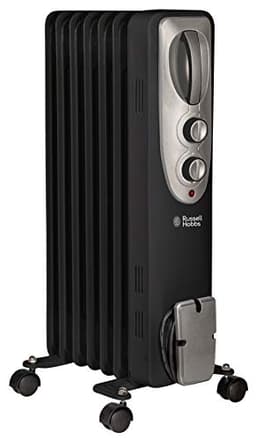 Best for Small RoomsRussell Hobbs 1500W 7-Fin Oil-Filled RadiatorA trusted-brand 1500W unit that is cheaper to buy and, because it draws less, cheaper to run.Why we picked it ↓£42.95● In stockCheck price
Compare the specs
| # | Product | Best for | Power | Fins | Controls | Cost per hour* | Price |
|---|---|---|---|---|---|---|---|
| NETTA 2500W Oil-Filled Radiator | Best Overall | 2500W | 11 | Thermostat + 24h timer | ~66p/hr | Out of stock | |
| 2 | VonHaus 2000W 9-Fin Oil-Filled Radiator | Best Value | 2000W | 9 | Thermostat, 3 settings | ~53p/hr | Out of stock |
| 3 | Russell Hobbs 1500W 7-Fin Oil-Filled Radiator | Best for Small Rooms | 1500W | 7 | Thermostat | ~39p/hr | £42.95 |
| 4 | AMOS 3000W 13-Fin Oil-Filled Radiator | Best for Large Rooms | 3000W | 13 | Thermostat | ~79p/hr | Out of stock |
| 5 | Dimplex ECR20 2kW Oil-Free Column Radiator | Best for Fast Warm-Up | 2000W | Oil-free column | Manual thermostat | ~53p/hr | Out of stock |
Prices are live from Amazon and refresh through the day; last page update 8 October 2026.
Do you actually need an oil-filled radiator?
Electric heating costs roughly four times as much per unit as gas, so the honest answer for most homes with central heating is: use this to heat one room you are actually in, not the whole house. Used that way it is genuinely cheaper than firing the boiler to warm a four-bed house so one person can sit in the lounge. Used as a substitute for central heating across a home, it will give you a frightening bill.
- Heating the one room you spend the evening in, while the rest of the house stays cool? This is exactly the job. Read on.
- A renter or in a home with no gas, or a room the central heating never quite reaches? A controllable plug-in radiator is a sensible, permission-free fix.
- Trying to heat the whole house on electric heaters? Stop. On the current price cap that is the most expensive way to stay warm. Insulation, draught-proofing and the central heating you already have will cost less.
- Need instant heat for five minutes while you grab something from a cold room? An oil-filled radiator is the wrong tool; it warms slowly. A fan heater suits that job.
The right mental model is "zone heating": warm the person and the room they occupy, turn it off when you leave, and let the thermostat do the rest. That is where oil-filled radiators shine, and where the savings are real.
Oil-filled vs convector vs fan vs halogen: pick by how you use the room
They all turn electricity into the same heat for the same money per kilowatt. The difference is how they deliver it, which decides which one suits you.
- Oil-filled radiator (this guide): warms slowly, then holds and radiates gentle heat, and keeps giving warmth after it switches off. Silent. Best for a room you sit in for hours, like a lounge, bedroom or home office.
- Oil-free column (our Dimplex pick): the same look and feel but heats faster and weighs less, at the cost of holding less warmth once off.
- Convector / panel: heats the air quickly and evenly, wall-mountable, but the warmth stops the moment it does. Good for quick, even background heat.
- Fan heater: near-instant heat aimed where you point it, but noisy and the warmth vanishes the second it is off. For short bursts, not sitting all evening.
- Halogen / radiant: heats you, not the room, like standing in sunshine. Cheap to buy, fine for spot warmth at a desk, useless for warming a whole room.
So: sitting still for hours in one room, buy oil-filled. Quick even warmth, convector. A five-minute blast, fan heater. Warming just yourself at a desk, radiant. Matching the type to the use does more for comfort and cost than any brand choice.
What wattage do you need?
Oil-filled radiators are sold by wattage, and bigger is not automatically better because you pay for every watt you draw. Rough guide for a reasonably insulated UK room:
- 1000 to 1500W: a small bedroom, study, box room or under-desk. Our Russell Hobbs pick sits here, and because it draws less it costs the least per hour.
- 2000W: an average bedroom, office or a well-insulated small lounge. The VonHaus and Dimplex picks.
- 2500W: an average living room or a chillier through-room. Our NETTA winner.
- 3000W: large, open-plan, cold or high-ceilinged rooms only. The AMOS pick, with the socket caveat below.
Two rules. First, undersizing is a false economy: a small heater left running flat out to heat a big room costs more and works worse than the right-sized unit that reaches temperature and cycles off. Second, anything rated 3000W must go straight into its own wall socket, never a multi-way extension lead, because 3kW is right at the limit of a 13A circuit and overloaded leads are a real fire risk.
What they actually cost to run
Running cost is just wattage times the electricity rate, so it is the one number you can work out exactly. At the current Ofgem price-cap rate of 26.32p per kWh (Direct Debit, October to December 2026), full-power costs are:
| Heater | Power | Cost per hour at full power* |
|---|---|---|
| Russell Hobbs 7-fin | 1500W | ~39p |
| VonHaus 9-fin / Dimplex ECR20 | 2000W | ~53p |
| NETTA (our winner) | 2500W | ~66p |
| AMOS 13-fin | 3000W | ~79p |
*At the Ofgem cap rate of 26.32p/kWh (Oct to Dec 2026). These are full-power figures. A thermostat cycles the radiator off once the room is warm, so real running costs are lower, often much lower, than continuous-running maths suggests.
The figure that is full power all the time is the worst case. In practice the thermostat is doing most of the saving for you: once your room hits temperature the element clicks off and only clicks back on to top up, so a 2500W radiator rarely averages anything like 2500W over an evening. That is why controls, not wattage alone, decide your bill.
Our picks in detail
NETTA 2500W Oil-Filled Radiator
The sensible default: 2500W for a real living room, a proper thermostat and a 24-hour timer, and it does it all in silence.
The reason this is the pick for most people is the 24-hour timer paired with the thermostat. Those two controls, not the heating element, are what decide your bill: the thermostat cycles the radiator off once the room is warm, and the timer stops it heating an empty room at 3am. A heater without them runs flat out whenever it is on, which is how people end up frightened of electric heating. The NETTA has both, plus multiple heat settings so you are not always drawing the full 2500W.
At 2500W it has the output for an average lounge or a chilly through-room, and like all oil-filled radiators it holds its warmth for a while after it switches off, so the room stays comfortable between cycles. It is silent, which matters in a room you actually sit in, and it comes up to temperature gently rather than blasting, which is the oil-filled trade-off: slower to warm than a fan heater, far more pleasant once it gets there. For a single everyday room heater, this is the one to buy and stop thinking about.
What we like
- Thermostat and 24-hour timer, the controls that actually cut the bill
- Silent in use, unlike any fan heater
- 2500W suits an average living room
- Holds warmth after it cycles off
What we'd change
- Slow to warm a room from cold, as all oil-filled radiators are
- Heavy to move between rooms
Buy this if: you want one quiet, controllable radiator for a room you sit in for hours.
VonHaus 2000W 9-Fin Oil-Filled Radiator
The budget workhorse: 2000W, a thermostat and three heat settings for noticeably less money.
One of the most-reviewed oil-filled radiators on Amazon UK.
VonHaus is the brand the UK actually buys at this price, and the 2000W 9-fin is its staple for good reason. You get an adjustable thermostat and three heat settings (typically 800W, 1200W and the full 2000W), which is the control that matters: drop it to a lower setting for background warmth and it sips rather than gulps. For a bedroom, a home office or a well-insulated small lounge, 2000W is plenty.
What you give up against the winner is the timer, so you are switching it on and off yourself or adding a cheap plug-in timer socket. The build is honest-to-the-price plastic-and-steel rather than premium, and it warms gently like every oil-filled unit. None of that matters much when it costs about 53p an hour at full power, less on a lower setting, and does the core job without fuss. If the budget is tight, start here.
What we like
- Adjustable thermostat and three heat settings
- Lower 2000W draw suits most bedrooms and offices
- Keenly priced and widely reviewed
What we'd change
- No built-in timer
- Build quality matches the price
Buy this if: you want solid background warmth for a bedroom or office for the least money.
Russell Hobbs 1500W 7-Fin Oil-Filled Radiator
A trusted-brand 1500W unit that is cheaper to buy and, because it draws less, cheaper to run.
Thousands of Amazon reviews at our last count.
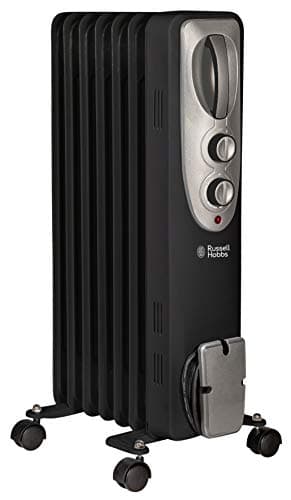
This is the one point in the guide where a model genuinely costs less to run, and it is not magic: at 1500W it draws less power than the bigger picks, so it costs about 39p an hour at full tilt against 53p to 66p for the 2000W to 2500W units. The catch is simple physics. Less power means less heat, so this is for small spaces: a study, a box room, a small bedroom or taking the edge off under a desk.
Russell Hobbs is a reassuringly familiar name at the budget end, the thermostat holds a set temperature, and the smaller 7-fin body is lighter to shift between rooms than the heavier units above. Ask it to heat a draughty lounge and it will struggle and run constantly, which defeats the point. Matched to the right small room, it is the cheapest sensible way to stay warm.
What we like
- Lower 1500W draw means genuinely lower hourly cost
- Lighter and easier to move than the bigger picks
- Thermostatic control from a familiar brand
What we'd change
- Underpowered for lounges and large or draughty rooms
- No timer
Buy this if: the room is small; this is the cheapest-to-run pick as long as you do not overask it.
AMOS 3000W 13-Fin Oil-Filled Radiator
Maximum output for big, cold or open-plan rooms, with the wiring caveat that comes with 3000W.
When one radiator has to warm a large lounge, an open-plan space or a cold old room with high ceilings, 3000W and 13 fins give you the output the smaller units cannot. More fins mean more surface area radiating heat, and the thermostat still cycles it so you are not paying for 3000W continuously once the room is up to temperature.
The honest caveat is electrical, not thermal. At 3000W this sits right at the ceiling of what a standard UK 13A socket delivers, so it must go straight into a wall socket on its own, never a multi-way extension lead or a daisy-chained adaptor, which is a genuine fire risk at this wattage. It is also the dearest to run at full power, about 79p an hour, so size honestly: if a 2000W to 2500W unit will heat your room, it will cost you less. Buy the 3000W only when the room really needs it.
What we like
- Highest output here for large or cold rooms
- 13 fins spread a lot of radiant warmth
- Thermostat still manages the cycling
What we'd change
- Must use its own wall socket, never an extension lead
- Dearest to run at full power
- Overkill, and overspend, for an average room
Buy this if: the room is genuinely large or cold and a 2500W unit cannot keep up.
Dimplex ECR20 2kW Oil-Free Column Radiator
A trusted-brand oil-free column heater that warms up faster and is lighter to carry, if you can skip the timer.
Oil-free column heaters like the Dimplex ECR20 look like an oil-filled radiator but heat a thermal element directly rather than warming a reservoir of oil, so they reach temperature noticeably faster and weigh less to move around. Dimplex is the most trusted name in UK electric heating, and if your gripe with oil-filled units is the slow start, this is the fix at the same 2000W and a similar running cost of about 53p an hour.
The trade-offs are that it holds less residual heat once it switches off, since there is no oil to stay warm, and this particular model uses manual controls rather than a programmable timer. If set-and-forget scheduling matters to you, the NETTA winner is the better buy; if a quicker warm-up and a lighter heater matter more, and you are happy to switch it yourself, the Dimplex earns its place on brand and speed.
What we like
- Warms up faster than oil-filled radiators
- Lighter to carry room to room
- Dimplex, the most trusted UK electric-heating brand
What we'd change
- Holds less heat after switching off
- Manual controls, no programmable timer
Buy this if: the slow warm-up of oil-filled units annoys you and you want a quicker, lighter heater.
The efficiency myth: why no electric heater is "cheaper to run" than another
This is the most important thing on the page, and the whole industry would rather you did not know it. Every mains electric heater is about 100% efficient at the point of use. Oil-filled, convector, fan, halogen, ceramic, fancy "German" panel, cheap supermarket special: they all convert essentially all the electricity they draw into heat in your room. The Energy Saving Trust is clear on this.
What that means in dire practice for your wallet: a 2000W heater emits 2000W of heat and costs the same to run as any other 2000W heater at the same rate, full stop. A £200 radiator marketed as "energy-saving" does not produce more heat per pound than a £50 one of the same wattage. If a listing claims its heater is "more efficient" or "uses less electricity" at a given wattage, it is marketing, not physics.
So where do real differences come from? Two places only. Controls: a thermostat and timer cut the hours the element actually runs, which is genuine saving. And heat delivery: a radiant heater that warms you directly may let you stay comfortable while heating less of the room, and an oil-filled radiator's retained warmth means it coasts between cycles. Buy for controls and the right heat type for your room. Never pay a premium for "efficiency" at a given wattage, because there is no such thing.
How to actually cut the cost of electric heating
Since you cannot buy your way to a cheaper-per-watt heater, here is where the savings really are:
- Use the thermostat, not the on switch. Set a temperature and let the radiator cycle itself. Running it flat out and opening a window when it gets too warm is money on fire.
- Use a timer, built in or a cheap plug-in one, so it never heats an empty room. Warm the lounge for the hour before you sit down, not all afternoon.
- Heat one zone, not the house. The entire case for a plug-in radiator is warming the room you are in while the boiler stays off. Close the door.
- Drop the target by one degree. Each degree lower is a meaningful cut over a winter, and you rarely notice it in a jumper.
- Kill the draughts first. A £10 draught excluder under the door keeps the heat you have paid for in the room. No heater beats stopping the warmth leaking out.
- Pair it with a dehumidifier in a damp room. Dry air feels warmer at the same temperature, so tackling condensation and damp can let you run the heater lower.
Using an oil-filled radiator safely
- Straight into a wall socket. 2000W to 3000W is a heavy, sustained load. Do not run it through a multi-way extension lead or a travel adaptor; overloaded leads overheat. A 3000W model in particular needs its own socket.
- Give it space and keep it upright. Keep it clear of curtains and furniture, and only use it standing as designed. Most have a tip-over cut-off, which is worth having.
- Do not drape wet clothes over it. Oil-filled radiators run cooler than a bar fire, but covering one traps heat and dumps moisture into the room. Dry laundry on an airer with a dehumidifier instead.
- Not for permanently unattended rooms. Thermostats and timers make overnight use reasonable in a bedroom, but do not leave a heater running in an empty house for days.
- Check the lead and plug. On any high-wattage heater, a warm plug or a frayed lead is a stop-now signal.
Common myths, corrected
- "This brand of heater is cheaper to run." Not at the same wattage, it is not. Same watts, same heat, same cost. Controls and sizing change your bill; the badge does not.
- "Oil-filled radiators use oil, so there is a running cost for the oil." No. The oil is a sealed heat reservoir that never needs topping up or replacing. The only running cost is the electricity that warms it.
- "A bigger, higher-wattage heater is better." Only for bigger rooms. In a small room a 3000W unit just costs more to reach the same temperature a 1500W unit would hold.
- "Electric heaters are always expensive." As whole-house heating, yes. As a way to warm the single room you are in while the boiler stays off, they can be the cheaper choice. It is all about zoning.
- "Leave it on low all day so it does not use energy warming up." Oil-filled radiators do not have a meaningful warm-up penalty worth paying all-day standby for. A timer that heats the room shortly before you use it costs less.
What we’d skip
- Any heater sold as "energy-saving", "eco" or "uses 50% less electricity" at a given wattage. There is no such thing: a 2kW heater is a 2kW heater. You are paying a premium for a physics claim that cannot be true.
- Running a 2500W or 3000W radiator through a multi-way extension lead or travel adaptor. It is a genuine fire risk at that load. If it will not reach a wall socket, move the heater, not the rules.
- Halogen and bar fires as a main room heater. They warm whatever they point at, not the room, so you roast on one side and shiver on the other. Fine as spot heat at a desk, wrong for an evening in the lounge.
- Tiny "900W mini heaters" marketed to heat a whole room for pennies. At 900W they cannot heat a cold lounge, and the pennies claim only holds because they barely heat anything.
- Fake RRP anchoring, which is everywhere in heaters each autumn. A £55 radiator permanently "reduced" from £150 was never £150. Judge the price you pay against the reviews, not the crossed-out number.
Frequently asked questions
How much does an oil-filled radiator cost to run in the UK?
At the current Ofgem rate of 26.32p per kWh, a 2000W radiator costs about 53p an hour and a 2500W about 66p an hour at full power. Because the thermostat cycles the element off once the room is warm, real running costs over an evening are lower, often much lower, than those full-power figures.
Which electric heater is cheapest to run?
At the same wattage they all cost the same, because every electric heater is about 100% efficient. The cheapest to run is simply the lowest-wattage one that can heat your room, paired with a thermostat and timer so it is not running when it does not need to be. Ignore any "more efficient" marketing.
Do oil-filled radiators need refilling with oil?
No. The oil is a sealed internal heat reservoir that is never topped up or changed for the life of the heater. It only stores and releases warmth; the running cost is purely the electricity used to heat it.
What wattage oil-filled radiator do I need?
Roughly 1000 to 1500W for a small bedroom or study, 2000W for an average bedroom or office, 2500W for a living room, and 3000W only for large, cold or open-plan rooms. Undersizing makes the heater run flat out and costs more, so match it to the room.
Can I run a 3000W heater on an extension lead?
No. At 3000W the heater is at the top of what a 13A socket safely delivers, so it must go straight into its own wall socket. Multi-way extension leads and travel adaptors can overheat under that sustained load, which is a real fire risk. This applies to any high-wattage heater.
Oil-filled radiator or fan heater: which is better?
Different jobs. An oil-filled radiator warms slowly then holds gentle, silent heat, which suits a room you sit in for hours. A fan heater gives near-instant heat but is noisy and the warmth stops the moment it is off, which suits short bursts. For an evening in the lounge, choose oil-filled.
Are oil-filled radiators safe to leave on overnight?
With a thermostat and a tip-over cut-off, oil-filled radiators are among the more suitable electric heaters for overnight use in an occupied bedroom, set to a low temperature. Keep them clear of curtains and bedding, plug straight into the wall, and do not leave one running in an empty house.
Can I dry clothes on an oil-filled radiator?
Better not to. Covering a radiator traps its heat and pushes litres of moisture into the room, which causes condensation and mould. Dry laundry on an airer, ideally alongside a dehumidifier, which is cheaper and kinder to both your clothes and your walls.
Ready to choose?
Our one clear winner is the NETTA 2500W Oil-Filled Radiator.