
The Best Pull-Up Bar (UK, 2026)
By Niko Moustoukas, Founder & Editor
Published 14 October 2026
If you want a cheap, effective way to train pull-ups at home with no drilling, buy a doorway pull-up bar, and the Sportneer is our pick. It hooks over the door frame, holds securely on a suitable frame using your bodyweight as leverage, offers multiple grips for pull-ups, chin-ups and more, and takes seconds to put up and take down. For back, arm and grip strength with almost no space or cost, nothing beats it, provided your door frame is up to the job.
On a budget a basic bar does the same for around a tenner; for comfort a padded multi-grip bar is kinder on the hands; for peace of mind a heavy-duty 200kg bar adds margin; and an adjustable-width bar fits awkward or narrow doorways. But before any of that, read the safety section, because a doorway bar on the wrong frame is the one piece of home fitness kit that can genuinely drop you, and knowing whether your frame suits one is the whole game.
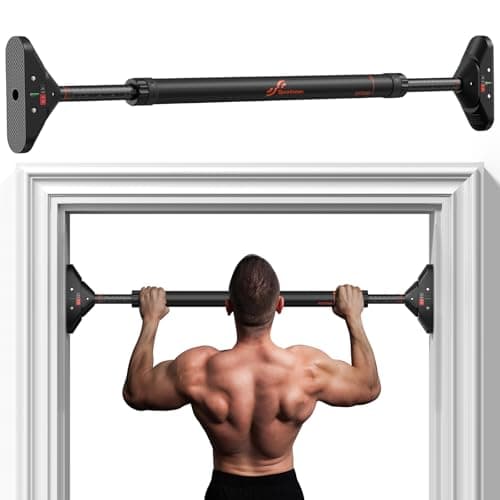
The winner · Best Overall
Sportneer Doorway Pull-Up Bar
Secure on a suitable frame, multiple grips, padded where it counts, and no screws: the dependable doorway bar for most people.
Price checked live · updated 14 October 2026 · we may earn a commission
The top 5, ranked
 ★ Our pick · Best OverallSportneer Doorway Pull-Up BarSecure on a suitable frame, multiple grips, padded where it counts, and no screws: the dependable doorway bar for most people.Why we picked it ↓£28.04● In stockCheck price
 Best BudgetOZE Sports Doorway Pull-Up BarThe cheap way to start doing pull-ups at home, for around a tenner, if your frame suits it.Why we picked it ↓£10.99● In stockCheck price
 Best for Grip ComfortZENO Padded Multi-Grip Pull-Up BarGenerous padded handles and multiple grips, for comfortable longer sessions and kinder hands.Why we picked it ↓£14.95● In stockCheck price
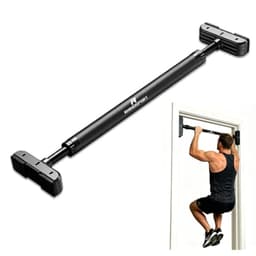 Best Heavy-DutyRHINOSPORT Pull-Up Bar (200kg, Narrow Doorways)A high 200kg capacity and a fit for narrower doorways, for heavier users or anyone who wants more margin.Why we picked it ↓£25.49● In stockCheck price
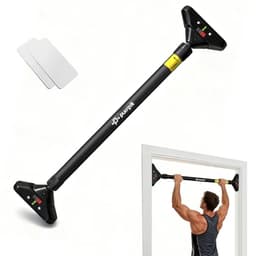 Best for Awkward DoorwaysPURRGRIT No-Screw Adjustable Pull-Up BarAdjustable width to fit varied or narrow doorways, for homes where a fixed-width bar will not sit right.Why we picked it ↓£25.49● In stockCheck price
Compare the specs
| # | Product | Best for | Mount | Fits width | Capacity | Grips | Price |
|---|---|---|---|---|---|---|---|
| Sportneer Doorway Pull-Up Bar | Best Overall | Leverage, no screws | Standard doorways | High | Multiple | £28.04 | |
| 2 | OZE Sports Doorway Pull-Up Bar | Best Budget | Leverage, no screws | Standard doorways | Standard | Basic | £10.99 |
| 3 | ZENO Padded Multi-Grip Pull-Up Bar | Best for Grip Comfort | Leverage, no screws | Standard doorways | Standard | Multiple, padded | £14.95 |
| 4 | RHINOSPORT Pull-Up Bar (200kg, Narrow Doorways) | Best Heavy-Duty | Leverage, no screws | ~70 to 92cm | ~200kg | Multiple | £25.49 |
| 5 | PURRGRIT No-Screw Adjustable Pull-Up Bar | Best for Awkward Doorways | Leverage, adjustable | ~74 to 95cm | High | Multiple | £25.49 |
Prices are live from Amazon and refresh through the day; last page update 14 October 2026.
The safety catch: your door frame holds you, not the bar
This is the single most important thing about doorway pull-up bars, so read it before buying. A no-screw doorway bar does not attach to anything; it hooks over your door frame and uses your bodyweight as leverage to press against the frame and the wall above the doorway. That means the bar is only as safe as the frame it levers against. On a solid frame, it is secure. On an unsuitable one, it can slip or pull away, and drop you.
Before you hang from one:
- You need a solid door frame with a proper architrave or lip for the bar to hook over and lever against. Plain openings, flush frames with no lip, or flimsy trim are not safe.
- Beware plasterboard or weak reveals. If the wall above the door is hollow or the trim is lightweight, the bar has nothing solid to press against.
- Fit it exactly to the instructions, fully seated and level, and check it is secure before putting full weight on it.
- Test cautiously. Put weight on gradually with your feet still able to take over, rather than jumping up and hanging immediately, and never yank or kip wildly on a doorway bar.
- Expect some marking of paint and trim over time; padding reduces it but does not prevent it.
If your frames are not up to it, do not force it. A wall-mounted bar or a free-standing option is the safer route (below).
When a doorway bar is not the answer
Doorway bars are brilliant value, but they are not right for every home or every user. Consider the alternatives if:
- Your door frames are unsuitable (no lip, flimsy trim, plasterboard). A wall-mounted bar, bolted into solid masonry or timber, is far more secure, at the cost of drilling and a permanent fixture.
- You want maximum stability or to do dips and more. A free-standing power tower is the most secure option and adds dips and other stations, though it takes up floor space.
- You cannot yet do a pull-up. You do not need to buy your way to one: a resistance power band looped over any bar assists you, taking some of your bodyweight so you can build up to unassisted reps.
For most people with a solid door frame, a doorway bar is the cheap, no-DIY winner. Match the solution to your home and your weight, and never force a doorway bar onto a frame that cannot safely take it.
Our picks in detail
Sportneer Doorway Pull-Up Bar
Secure on a suitable frame, multiple grips, padded where it counts, and no screws: the dependable doorway bar for most people.
A best-selling doorway bar with a large review history.
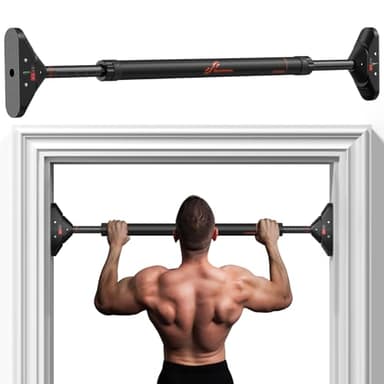
The Sportneer does everything a doorway pull-up bar should: it hooks over the frame and uses your bodyweight as leverage for a secure hold with no screws, it offers several grip positions (wide, narrow and neutral) so you can train your back, biceps and grip in different ways, and it comes up and down in seconds for storage. The build and padding are a cut above the cheapest bars, and the huge review history reflects a product that just works on a proper door frame.
As with every doorway bar, that last point is the catch: it is only as safe as your frame, so you must have a solid frame with a proper architrave lip for it to lever against (see below). It can also mark paint over time, which foam padding helps with but does not eliminate. On a suitable frame, fitted properly, it is a brilliant, cheap way to build pulling strength at home, and the one we would point most people to first.
What we like
- Secure leverage hold with no screws
- Multiple grip positions for varied training
- Padded, better built than the cheapest bars
- Up and down in seconds
What we'd change
- Only as safe as your door frame
- Can mark paint and trim over time
Buy this if: you have a solid door frame and want a dependable, well-made bar.
OZE Sports Doorway Pull-Up Bar
The cheap way to start doing pull-ups at home, for around a tenner, if your frame suits it.
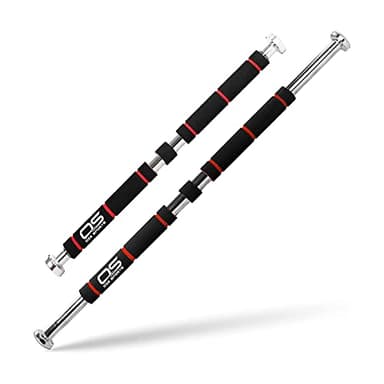
If you just want to start doing pull-ups without spending much, the OZE does the core job for around £10. It is a simple doorway bar with padded grips that hooks over the frame using leverage, no tools needed, and for bodyweight pull-ups and chin-ups it is all a lot of people require. At this price, it is an easy way to find out whether you will actually use a pull-up bar before spending more.
The compromises are the expected ones: fewer grip options, a more basic build and padding than the pricier bars, and the same absolute dependence on a suitable door frame. It is not for the heaviest users pushing the limits of a budget bar. But as a cheap, cheerful entry point for home pulling work, it is honest value, and a reminder that you do not need to spend much to train pull-ups. Check your frame, fit it carefully, and get pulling.
What we like
- Very cheap, around £10
- Padded grips, no tools to fit
- Does the core pull-up job
What we'd change
- Basic build and fewer grips
- Same door-frame dependence; not for heaviest use
Buy this if: you want the cheapest way to start pull-ups and your frame suits a bar.
ZENO Padded Multi-Grip Pull-Up Bar
Generous padded handles and multiple grips, for comfortable longer sessions and kinder hands.
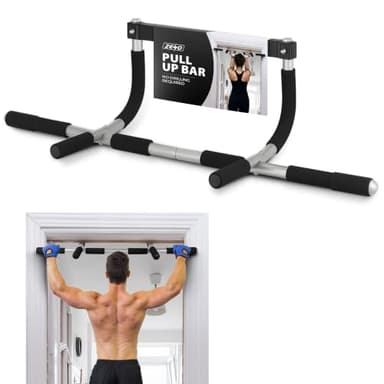
Pull-up bars can be hard on the hands, especially when you are building up and hanging for a while, and the ZENO addresses that with generously padded handles across multiple grip positions. If you find thin metal bars dig in, or you want to do longer hangs and higher-rep sets comfortably, the extra padding makes a real difference, and the varied grips let you target your back and arms from different angles.
It is still a leverage-mounted doorway bar, so the usual frame rules apply, and padding does not change how it holds or make an unsuitable frame safe. It is a touch more than the bargain bars for the comfort and grips. But for anyone who finds hard bars uncomfortable, or who will spend real time hanging and training, the padded grips are a small, worthwhile upgrade. If comfort is not an issue for you, a cheaper bar does the same job.
What we like
- Generously padded handles, kinder on the hands
- Multiple grip positions
- Comfortable for longer sessions and hangs
What we'd change
- Still leverage-mounted; frame rules apply
- Slightly more than bargain bars
Buy this if: you want comfortable padded grips for longer or higher-rep sessions.
RHINOSPORT Pull-Up Bar (200kg, Narrow Doorways)
A high 200kg capacity and a fit for narrower doorways, for heavier users or anyone who wants more margin.
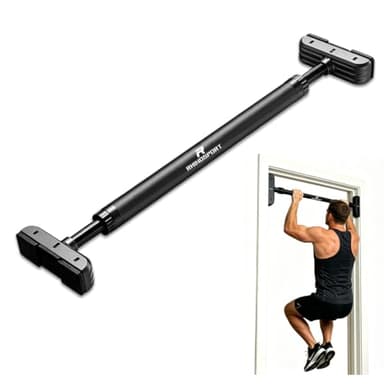
If you want more confidence in the numbers, the RHINOSPORT is rated to around 200kg and is designed to fit narrower doorways (roughly 70 to 92cm), which suits heavier users, anyone doing weighted pull-ups, or simply those who want a comfortable safety margin over a standard bar. A higher rated capacity generally also reflects a sturdier build, which is reassuring on a bar you hang your full weight from.
It is still a doorway bar relying on a sound frame, so capacity on the box does not override the need for a solid frame to lever against. And it is dearer than the budget bars. But if you are a heavier user, add weight to your pull-ups, or just want the reassurance of extra margin, paying a little more for a higher-rated, sturdier bar is sensible. For lighter users on a good frame, the standard bars are fine.
What we like
- High ~200kg rated capacity, sturdier build
- Fits narrower doorways
- Reassuring margin for heavier or weighted use
What we'd change
- Still needs a solid door frame
- Dearer than budget bars
Buy this if: you are a heavier user, do weighted pull-ups, or want extra margin.
PURRGRIT No-Screw Adjustable Pull-Up Bar
Adjustable width to fit varied or narrow doorways, for homes where a fixed-width bar will not sit right.
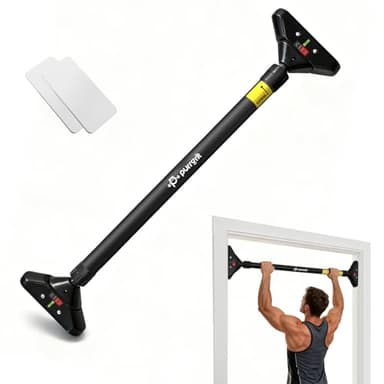
Not every doorway is a standard size, and a bar that does not fit properly is a non-starter. The PURRGRIT adjusts in width (roughly 74 to 95cm) with a locking mechanism and no screws, so it fits a range of doorways that a fixed bar would not, which matters in older homes, flats and anywhere with non-standard frames. The adjustability is the point: get a secure, well-sized fit in the doorway you actually have.
It is a leverage-and-fit doorway bar, so, as ever, it needs a sound frame and correct fitting, and the adjustment does not change that fundamental. It costs a little more than a fixed bar for the flexibility. But if a standard bar will not fit your doorway, or you want one bar to move between differently sized doors, the adjustable width solves a real problem. If your doorway is standard, a fixed bar is simpler and cheaper.
What we like
- Adjustable width for varied or narrow doorways
- No-screw fit with a locking mechanism
- Solves non-standard doorway problems
What we'd change
- Still needs a sound frame and correct fitting
- Dearer than a fixed-width bar
Buy this if: your doorway is non-standard and a fixed-width bar will not fit.
What to check when choosing
- Your doorway size, first and foremost. Measure the width and check the bar fits; an adjustable-width bar solves non-standard doorways.
- Weight capacity, comfortably above your bodyweight (and more if you add weight). Higher capacity usually means a sturdier bar.
- Grip positions. Multiple grips (wide, narrow, neutral) let you train your back and arms from different angles and are more comfortable.
- Padding, on the handles for comfort and on the frame contact points to reduce marking.
- Frame suitability, as above: a solid frame with a lip is non-negotiable for a leverage bar.
- Ease of removal, if the doorway is in daily use and the bar needs to come down between sessions.
Common myths, corrected
- "A higher weight rating means it is safe for me." Only if your frame is sound. The rating is the bar; the frame is what actually holds you. A 200kg bar on a flimsy frame is not safe.
- "No screws means no damage." Leverage bars can still mark paint and trim where they press. Padding helps, but expect some marking over time.
- "Any doorway works." No. You need a solid frame with a proper architrave lip. Flush frames, flimsy trim and plasterboard reveals are not safe, which is the whole safety story.
- "You need an expensive bar to do pull-ups." No. A £10 bar on a good frame builds pulling strength perfectly well. Pay more for comfort, capacity margin or adjustable fit, not for the pull-up itself.
- "If you cannot do a pull-up, a bar is pointless." No. Loop a resistance band over it to take some of your weight and build up to unassisted reps. The bar plus a band is how most people get their first pull-up.
What we’d skip
- Using a doorway bar on an unsuitable frame. Leverage bars rely on a solid frame with a proper lip; flush frames, flimsy trim and plasterboard reveals cannot safely take your weight. If your frame is not up to it, use a wall-mounted or free-standing bar instead.
- Trusting the weight rating over the frame. The number on the box is the bar, not your doorway. Check the frame is sound and fit the bar correctly before you hang from it, whatever the capacity claims.
- Jumping up and hanging immediately, or kipping wildly, on a doorway bar. Load it gradually with your feet able to take over, and keep movements controlled, because a sudden jerk is what unseats a leverage bar.
- Buying an expensive bar for the pull-up itself. A cheap bar on a good frame does the job. Spend more only for comfort padding, extra capacity margin, or an adjustable fit for an awkward doorway.
- Assuming you must be able to do a pull-up already. If you cannot, a resistance band looped over the bar assists you to build up. Do not skip the bar; just add a band.
Frequently asked questions
Are doorway pull-up bars safe?
On a solid door frame with a proper architrave lip, fitted correctly, yes. The catch is that a no-screw bar holds by levering against your frame, so it is only as safe as that frame. Flush frames, flimsy trim or plasterboard reveals are not safe, and on those you should use a wall-mounted or free-standing bar instead.
Will a pull-up bar damage my door frame?
It can mark paint and trim over time where it presses against the frame, even on no-screw leverage bars. Padding on the contact points reduces it but does not fully prevent it. If pristine trim matters, consider a wall-mounted bar on a surface you do not mind drilling, or accept some marking as the cost of a no-DIY bar.
What kind of door frame do I need?
A solid frame with a proper architrave or lip for the bar to hook over and lever against, and sound structure above the doorway. Lightweight trim, flush frames with no lip, and hollow plasterboard reveals are not safe for a leverage bar. If in doubt about your frame, choose a wall-mounted or free-standing option instead.
What weight can a doorway pull-up bar hold?
Bars are typically rated from around 100kg up to 200kg or more, and you should choose one comfortably above your bodyweight, with extra if you add weight. But the rating is the bar, not your doorway: a high capacity means nothing on a frame that cannot take the load, so the frame matters as much as the number.
Can I use a doorway bar if I cannot do a pull-up yet?
Yes, and it is one of the best ways to build up to one. Loop a resistance power band over the bar and put a foot or knee in it, and the band takes some of your bodyweight so you can train the full movement, dropping to lighter bands as you get stronger until you can do an unassisted pull-up.
Doorway, wall-mounted or free-standing pull-up bar?
A doorway bar is cheapest and needs no DIY, ideal if you have a solid frame. A wall-mounted bar, bolted into masonry or timber, is far more secure and permanent. A free-standing power tower is the most stable and adds dips and other stations, but takes floor space. Choose by your frame, your weight and how much you will use it.
How do I fit a doorway pull-up bar safely?
Follow the instructions exactly, seat it fully over the frame and ensure it is level and secure before loading it. Then test cautiously, putting weight on gradually with your feet able to take over rather than jumping straight into a hang, and keep your movements controlled. A sudden jerk or kip is what unseats a leverage-mounted bar.
Are expensive pull-up bars worth it?
Not for the pull-up itself: a cheap bar on a sound frame builds strength just as well. You pay more for comfort padding, multiple grips, a higher capacity margin for heavier or weighted use, or an adjustable width to fit an awkward doorway. Decide which of those you actually need, rather than assuming dearer is safer.
Ready to choose?
Our one clear winner is the Sportneer Doorway Pull-Up Bar.