
The Best Microwave (UK, 2026)
By Niko Moustoukas, Founder & Editor
Published 14 October 2026
If you want one microwave for everyday reheating, defrosting and cooking, buy a 23L solo model from a trusted brand, and the Samsung is our pick. The 23L capacity fits a dinner plate and family-sized dishes comfortably, Samsung's triple-distribution system heats more evenly than cheap microwaves that leave cold spots, and it is a well-built machine at a fair price. For the vast majority of kitchens, a good solo microwave like this does everything you actually ask of one.
The choices beyond that are simple. A grill microwave adds browning; a combi adds a proper oven function for baking and roasting, worth it only if you will genuinely use it; and inverter models cook and defrost more gently and evenly. Below we explain solo versus grill versus combi, what wattage and capacity you need, and the one check people forget, whether your dinner plates actually fit on the turntable.
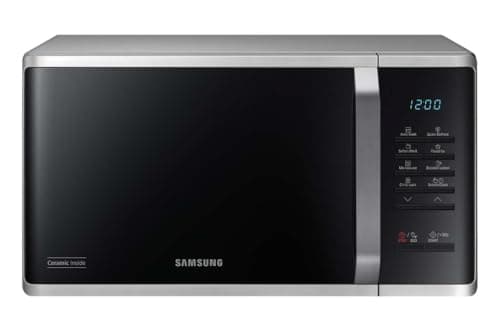
The winner · Best Overall
Samsung 23L Solo Microwave (Triple Distribution)
A 23L solo from a trusted brand with more even heating: the microwave most households should buy.
Price checked live · updated 14 October 2026 · we may earn a commission
The top 4, ranked
 ★ Our pick · Best OverallSamsung 23L Solo Microwave (Triple Distribution)A 23L solo from a trusted brand with more even heating: the microwave most households should buy.Why we picked it ↓£98.99● In stockCheck price
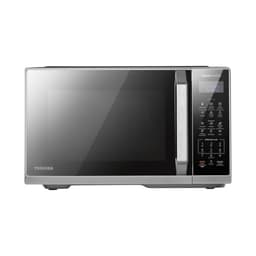 Best ValueToshiba 23L Digital Solo Microwave (900W, Mirror Finish)More power at 900W, a 23L capacity and a smart mirror finish, for less than the Samsung.Why we picked it ↓£84.97● In stockCheck price
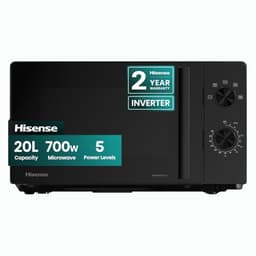 Best for Even CookingHisense 20L Inverter Microwave (700W)Inverter power for gentler, more even cooking and better defrosting, in a compact 20L body.Why we picked it ↓£59.00● In stockCheck price
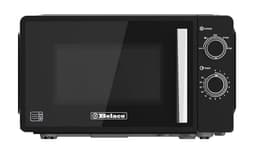 Best BudgetBelaco 800W Compact MicrowaveA simple 800W compact microwave with manual controls for under £50.Why we picked it ↓£49.99● In stockCheck price
Compare the specs
| # | Product | Best for | Type | Power | Capacity | Best for | Price |
|---|---|---|---|---|---|---|---|
| Samsung 23L Solo Microwave (Triple Distribution) | Best Overall | Solo | 800W | 23L | Most households | £98.99 | |
| 2 | Toshiba 23L Digital Solo Microwave (900W, Mirror Finish) | Best Value | Solo | 900W | 23L | Value, faster cooking | £84.97 |
| 3 | Hisense 20L Inverter Microwave (700W) | Best for Even Cooking | Solo, inverter | 700W | 20L | Even cooking, defrosting, small kitchens | £59.00 |
| 4 | Belaco 800W Compact Microwave | Best Budget | Solo | 800W | Compact | Budget, second microwave | £49.99 |
Prices are live from Amazon and refresh through the day; last page update 14 October 2026.
Solo, grill or combi?
This decides what you pay and what the microwave can do:
- Solo: reheats, defrosts and cooks with microwaves only. Cheapest and simplest, and all most people ever need. Our main picks.
- Grill: adds a grill element so you can brown and crisp the top of food, cheese on toast, gratins, crisping a ready meal. A modest step up in price and capability.
- Combi (convection): adds a fan oven function so it can bake and roast as well as microwave. The most versatile and the most expensive, but it is a compromise oven, smaller and often slower than a real one.
Be honest about which you need. Most households only ever use a microwave to reheat and defrost, so a solo is the sensible, cheaper buy. Only pay for a grill or combi if you will genuinely use those functions rather than just reheating in an expensive machine.
What wattage and capacity do you need?
- Wattage: higher is faster and more even. 800 to 900W cooks noticeably quicker and more evenly than 700W, which is worth having for everyday use. Lower-watt machines take longer and are more prone to uneven heating.
- Capacity: 20L is compact, fine for one or two people and small kitchens; 23 to 25L is the family sweet spot that fits a dinner plate and normal dishes; 28L and up suits large households and big dishes.
- The check people forget: make sure your actual dinner plates and serving dishes fit on the turntable and turn freely. A microwave that looks big enough on paper can still be too small inside for your plates.
What is an inverter microwave?
Standard microwaves only run at full power, and simulate lower settings by pulsing the full power on and off. An inverter microwave instead delivers a steady, genuinely lower power.
- More even cooking, with fewer scalding-edges-cold-middle results.
- Better defrosting, thawing food through without cooking the edges, which is the classic problem with cheaper machines.
- Gentler reheating of delicate foods that would otherwise overcook in spots.
It is a genuine quality upgrade for cooking and defrosting rather than marketing, and worth seeking out if those matter to you.
Our picks in detail
Samsung 23L Solo Microwave (Triple Distribution)
A 23L solo from a trusted brand with more even heating: the microwave most households should buy.
A popular family solo microwave.
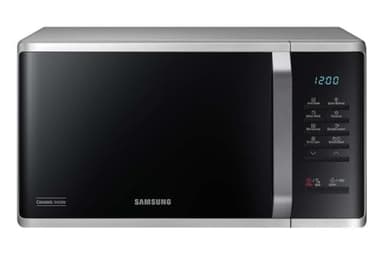
The Samsung 23L solo is the microwave most people should buy. The 23L capacity is the family sweet spot, big enough for a dinner plate and normal serving dishes without hogging the worktop, and Samsung's triple-distribution system spreads the microwave energy more evenly, which means fewer of the scalding-edges-cold-middle results that plague cheap machines. It is a well-built, well-specced solo from a brand you can trust, at a sensible price.
As a solo it does not grill or bake, so if you specifically want to crisp or roast in it you need a grill or combi model instead. But for the everyday reality of microwaving, reheating leftovers, defrosting, cooking veg and ready meals, heating drinks, it does all of it well and evenly, which is what actually matters day to day. For most households this is the right balance of size, build and even cooking, and the honest default pick.
What we like
- 23L family capacity, fits a dinner plate
- More even heating, fewer cold spots
- Trusted brand, solid build
- Fair price
What we'd change
- Solo only, no grill or oven function
Buy this if: you want a dependable, even-heating family microwave for everyday jobs.
Toshiba 23L Digital Solo Microwave (900W, Mirror Finish)
More power at 900W, a 23L capacity and a smart mirror finish, for less than the Samsung.
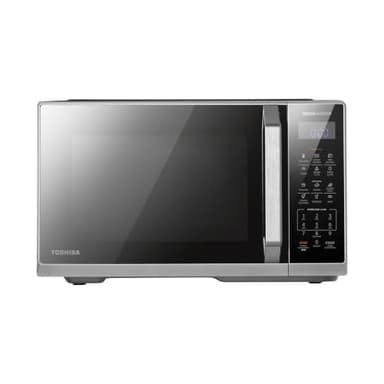
The Toshiba 23L is the value pick: you get a higher 900W output, the same family-friendly 23L capacity and a smart mirror-glass finish, usually for less than the Samsung. The extra wattage cooks and reheats a little faster and more evenly than 700 to 800W machines, the digital controls are easy to use, and the mirror front looks a cut above the usual white box, so it suits a modern kitchen without costing more for the privilege.
It is still a solo, so no grill or oven function, and Toshiba is a slightly less ubiquitous name than Samsung, though a thoroughly reputable one in microwaves. But for a fast, good-looking, even-cooking family solo at a keen price, it is hard to fault, and the extra power is a genuine plus. If you want the most trusted badge, the Samsung is our pick; if you want more watts and a smarter look for less, this is the value choice.
What we like
- Higher 900W output, faster cooking
- 23L family capacity
- Smart mirror finish
- Keen price
What we'd change
- Solo only
- Less ubiquitous brand than Samsung
Buy this if: you want more power and a smart finish for less money.
Hisense 20L Inverter Microwave (700W)
Inverter power for gentler, more even cooking and better defrosting, in a compact 20L body.
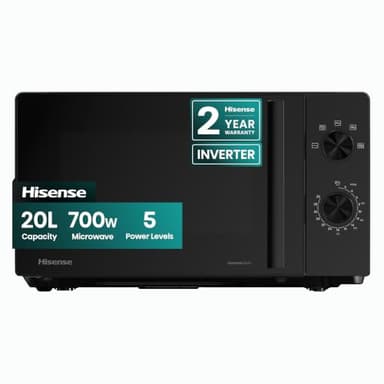
If even cooking and good defrosting matter to you, an inverter microwave like this Hisense is the one to get. Standard microwaves cook at full power and pulse on and off to simulate lower settings; an inverter delivers a steady, genuinely lower power instead, which cooks more gently and evenly and defrosts without cooking the edges of your food, a common frustration with cheaper machines. In a compact 20L body it suits smaller kitchens and one or two people well.
At 700W it is a touch slower at full blast than the 900W machines, and 20L is tighter for big dishes, so it is less suited to large families or those who want maximum speed and space. But for the quality of the cooking and defrosting, especially for delicate reheating and thawing meat properly, the inverter technology is a real, noticeable upgrade. If you want size and speed, choose a 23L 900W model; if you want the gentlest, most even results, this is the pick.
What we like
- Inverter: gentler, more even cooking
- Better defrosting without cooking edges
- Compact 20L for small kitchens
What we'd change
- 700W, slower at full power
- 20L is tight for big dishes
Buy this if: you want the most even cooking and best defrosting in a compact size.
Belaco 800W Compact Microwave
A simple 800W compact microwave with manual controls for under £50.
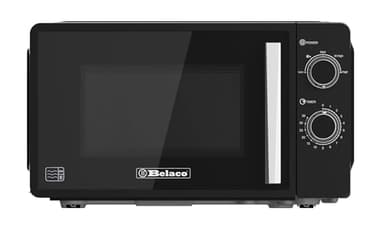
If you just want a microwave that reheats and defrosts and costs very little, the Belaco does exactly that for under £50. An 800W output handles everyday reheating and cooking at a sensible speed, the compact size suits small kitchens, spare rooms, offices and student digs, and the manual dial controls are about as simple and foolproof as it gets, nothing to fiddle with, nothing to go wrong. For a no-frills second microwave or a tight budget, it is honest value.
At this price the capacity is modest, the finish is basic, and manual dials mean no digital timer or presets. But a microwave's core job is to heat food, and this does that fine for the money, which is all a lot of people need. If you want more space, even inverter cooking or digital controls, spend a little more on one of the picks above; as the cheapest way to get a working, decent microwave, this is the budget choice.
What we like
- Cheap, under £50
- 800W, compact for small spaces
- Simple, foolproof manual controls
What we'd change
- Modest capacity, basic finish
- Manual dials, no digital timer or presets
Buy this if: you want the cheapest simple microwave for a small space.
Turntable or flatbed?
- Turntable: the familiar rotating glass plate. Cheapest and most common, and it helps even cooking by turning the food. The ring and plate take a little cleaning, and very large or square dishes can catch.
- Flatbed: no turning plate, so the whole floor is usable and large or square dishes fit better, and it is easier to wipe clean. Usually found on pricier models.
For most people a turntable is perfectly good and cheaper. A flatbed is a nice upgrade if you often heat large or awkwardly shaped dishes or want easier cleaning, but it is not essential.
Common myths, corrected
- "A combi microwave replaces your oven." Not really. It can bake and roast, but it is a compromise oven, smaller and often slower, so it suits small kitchens or extra capacity, not replacing a full oven for most people.
- "Wattage does not matter much." It does. 800 to 900W cooks faster and more evenly than 700W, which you notice on every reheat and when cooking from raw.
- "Bigger is always better." No. A large microwave takes more worktop space and is overkill for one or two people. Match the capacity to your household, and check your plates fit.
- "Inverter is just a marketing term." No. It delivers steady lower power for genuinely more even cooking and better defrosting, a real, noticeable difference.
What we’d skip
- Paying for a combi or convection microwave you will only ever use to reheat. If you will not genuinely bake and roast in it, you are paying a lot for an oven function you will not touch, and it is a compromise oven anyway. A solo does everyday reheating and defrosting for far less.
- Buying a 700W microwave if you want speed and even cooking. Higher wattage, 800 to 900W, cooks noticeably faster and more evenly, which you notice on every use. Low-watt machines are slower and more prone to cold spots.
- Forgetting to check your plates fit. A microwave that looks big enough on paper can still be too small inside for your dinner plates and dishes to turn freely. Check the usable internal size and turntable, not just the litre figure.
- Buying the biggest capacity by default. A large microwave hogs worktop space and is overkill for one or two people. Match the capacity to your household: 20L for small, 23 to 25L for a family.
- Dismissing inverter models as marketing. Inverter power genuinely cooks more evenly and defrosts far better than standard machines that just pulse full power on and off. If even cooking and defrosting matter to you, it is a real upgrade worth paying a little for.
Frequently asked questions
Solo, grill or combi microwave, which do I need?
Most people only need a solo, which reheats, defrosts and cooks and is the cheapest and simplest. A grill model adds a browning element for crisping and gratins. A combi adds a fan-oven function to bake and roast but costs much more and is a compromise oven, smaller and slower than a real one. Buy a grill or combi only if you will genuinely use those functions, not just to reheat in a pricier machine.
What wattage microwave is best?
For everyday use, 800 to 900W is the sweet spot: it cooks and reheats noticeably faster and more evenly than 700W machines, which take longer and are more prone to cold spots. Higher wattage matters most if you cook from raw or want speed. A 700W machine is fine for gentle reheating and defrosting, especially an inverter one, but for general family use more power is better.
What size microwave should I buy?
Match it to your household and your dishes. A 20L microwave is compact and fine for one or two people and small kitchens, 23 to 25L is the family sweet spot that fits a dinner plate and normal dishes, and 28L and up suits large households. Crucially, check your actual plates and serving dishes fit on the turntable and turn freely, as a microwave can look big enough on paper but be too small inside.
What is an inverter microwave and is it worth it?
An inverter microwave delivers a steady, genuinely lower power instead of pulsing full power on and off like standard machines. That means more even cooking with fewer hot and cold spots, and much better defrosting that thaws food without cooking the edges. It is a real quality upgrade rather than marketing, and worth paying a little more for if even cooking and good defrosting matter to you.
Can a microwave replace an oven?
A solo or grill microwave cannot; they reheat, defrost and cook but do not bake or roast properly. A combi (convection) microwave can bake and roast as well as microwave, so it can stand in for an oven, but it is a compromise, smaller and often slower than a full oven. It suits small kitchens, caravans or extra capacity rather than fully replacing a proper oven for most households.
Turntable or flatbed microwave?
A turntable, the rotating glass plate, is the common, cheaper option and helps even cooking by turning the food, though large or square dishes can catch and the plate needs cleaning. A flatbed has no turning plate, so the whole floor is usable, large and square dishes fit better, and it wipes clean easily, but it is usually found on pricier models. A turntable is fine for most people; a flatbed is a nice upgrade if you heat big or awkward dishes.
Why does my microwave heat unevenly?
Cheaper microwaves cook at full power and pulse it on and off, which leaves hot and cold spots, and energy is not spread evenly across the cavity. Stirring food part way through, arranging it in a ring rather than a pile, and using a lower power setting for longer all help. For genuinely more even results, a model with better energy distribution or an inverter cooks more evenly by delivering steady, lower power.
Are expensive microwaves worth it?
For basic reheating and defrosting, a good mid-range solo is all most people need, so a very expensive machine is not worth it. You pay more for grill and combi functions, inverter technology, a flatbed, higher wattage, larger capacity and better build. Those are worth it if you will use them, more even cooking and better defrosting in particular, but not if you only ever reheat leftovers.
Ready to choose?
Our one clear winner is the Samsung 23L Solo Microwave (Triple Distribution).